Translation: Google Translator
Please follow this page. More texts soon (or later)
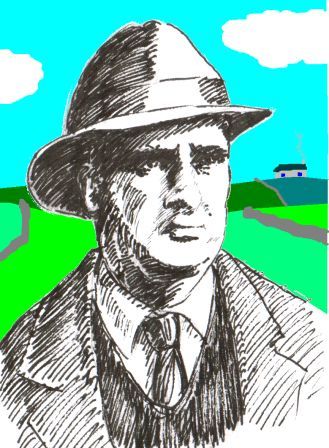
Infinity
According to canonical exegesis, de Selby’s „The Book” is a coded record of the Theory of Everything. Unfortunately, all attempts to read the enigmatic text unambiguously ended in failure. Of course, there are numerous translations of the „The Book” known as the Apocrypha, but there are not even two, although roughly compatible with each other. Critics reluctant to the Deselbian school point out that the inconsistency in attempts to read „The Book” confirms Garbandier’s thesis that its entries are completely pointless. Hatchjaw strongly counter to Garbandier’s attacks, giving a purely scientific examples of the countless Universal Theories put forward by ambitious physicists, which as a rule are inconsistent with each other, and no layman dares to call them absurd. Moreover, it is precisely the variety of readings that testifies to the omnipotence of „The Book” containing all possible or impossible hypotheses.
Kraus joined the debate by presenting the results of his research on the Deselbian symbolism of the potential science system, in which the ideogram of infinity replaced the statement: „I don’t know”, and it is commonly known that this sign closes the „The Book”.
Regression
In the system of the Deselbian potential science, there is no place for the notion of progress as positive change. The trait of positivity, which is subjective and therefore unscientific, has been rejected. The elimination of „positivity” made progress synonymous with change. In accordance with the principle of synonyms reduction, the word „progress” has been removed from the lexicon of potential science concepts. This did not end the process of simplifying language, because Kraus – one of de Selby’s self-proclaimed epigones – discovered that the notion of change presupposes a causal continuity of phenomena, and this, in turn, conflicts with the practice of empiricism, where only a sequence devoid of causal character is observed. Eventually, in the system of potential science, progress and change were replaced by succession, which essentially critical Du Garbandier called the Deselbian Regression.
IQ scale
Supposedly, in one of the lost brochures, de Selby presented the concept of a new IQ scale. He decided to extend the existing scale with negative values. On the basis of tests developed by himself, he concluded that his IQ is minus 160, which indicates a „specific genius”. As usual, the mischievous du Garbandier suggests that the introduction of the new scale was due to de Selby’s disastrous score in the conventional test. This is confirmed by the memories of a certain Bloom, who sold the standard test to de Selby. Upon reuniting, Bloom was said to be insulted and accused by de Selby of trading with false and defective tests. On the other hand, Kraus stated that the cause of the misunderstanding was a typographical error and instead of minus 160, de Selby obtained the square root of minus 160. The reserved Le Clerque, referring to the whole matter, wrote: „some comments tell more about the character of their author than about the subject of the discussion.”
Geodynamo
De Selby established a fruitful correspondence with Tesla regarding the planetary dynamo project to provide the necessary energy for „the water box” to initiate the condensation of atmospheric oxygen, which in turn would create a „heavenly fountain” that would be the focal point of the „water paradise”.
Correspondents quickly realized that their letters were controlled by the secret services of the Powers and therefore limited themselves to reflecting on the weather. Using carrier pigeons, Tesla sent significant letters containing the technical details of the geodynamo and other brilliant inventions. The long correspondence ended when de Selby heard from a pigeon fancier that the birds were not able to cross the Atlantic on their own.
Black holes
At one of the author meetings, de Selby was asked about black holes that had long held a high position in the ranking of cosmological curiosities and which some researchers now deny exist.
De Selby replied that the increasing tendency to deny the existence of black holes is an indication of their influence, as these objects absorb everything, including knowledge about themselves.
Connoisseur
Why did de Selby not admire the monuments and other works of art; why he was not interested in the fate of famous people; why was he not interested in politics…. why?
De Selby chose the path of Yorick, for whom the real adventure was getting to know another person, not seeing this or that or being here or there. Not a trip to the continent or even the Red Planet, but a short walk to a nearby pub to discover new worlds of human souls while tasting dark beer in casual company.
Disorder
Casey recalls that de Selby’s office was extremely cluttered and that to get to the desk you had to wade through piles of books and move some strange apparatuses covered with dust and cobwebs. When asked if this disorder made work difficult, the Ballisticsian replied that an accidental overturning of a stack of books sometimes made it possible to discover a forgotten volume, the content of which may inspire further work.
Casey’s question directed de Selby’s mind to explore the relationship between chaos and order. Ultimately, the Methodologist recognized the concepts of chaos and order as empty and excluded them from the scope of potential science. According to de Selby’s analysis, clutter and order are terms relative to human whim, because why should a creative disorder in tax returns be considered a mess or even a forgery by some overzealous tax inspector!?
„Could filling a simple tax return form be an impossible task for an individual aspiring to solve the mysteries of the universe?” Garbandier asked provocatively.
„Mr Garbandier’s statements prove that intellectual clutter is an inherent feature of the current public debate,” Hatchjaw responded.
„Fulfilling de Selby’s postulate to tax taxes could save global finances,” Kraus added.
Minority
De Selby did not agree with his name appearing in all sorts of dictionaries and encyclopedias. He believed that being classified into a group was a form of stigma and discrimination: „Why was I listed in „The Brief Dictionary of the Universal Geniuses” but not in „The Communal Directory of Local Liquor Producers”? The Empiricist asked, offended. Deep sociological analysis led him to believe that the only fair, non-discriminatory method of classification is the molecular method: each individual is a separate irreducible atomic class – the Smallest Minority, SM for short. Equal rights and obligations of all SMs will lead to universal non-discrimination of minorities.
State of overconcentration
De Selby complained many times about his tiring reading over books. No wonder he was enthusiastic about the art of speed reading. He quickly read a few guides on this subject. Dr Selby felt that the methods presented there were not entirely satisfactory and decided to develop his own. He presented the results of his work in a brochure modestly titled „The School of the Fastest Reading”. Unfortunately, dumb publishers were unable to appreciate the genius of the Thinker and decided not to publish this breakthrough work for science and education. De Selby published 100 copies of the brochure at his own expense, but unfortunately none have survived to our times. The few references scattered in other works of the Scholar make it possible to reconstruct only some elements of the „fastest reading” method. De Selby postulated to put the mind in a state of „overconcentration” before reading. After reaching this state, it is enough to read a few sentences from the selected book to „become aware” of the content of the entire work. In the next stage, this method allows you to assimilate the content of all his works after reading a few sentences from any book by a selected author. Unfortunately, de Selby did not specify how to achieve the state of „overconcentration”. Malignant as usual, du Garbandier stated that the dozen unpaid whiskey bills left by the Master clearly indicated how de Selby had entered a state of „overconcentration”. Hatchjaw replied that these allegedly unpaid bills had to be rigged because „it is common knowledge that de Selby was famous throughout the neighborhood for making excellent whiskey.”
Invariant of DS
In compiling his family tree, de Selby searched the local archives and visited several cemeteries in the area. On the basis of the conducted research, the Scholar put forward a bold thesis that everyone must die. This principle was later dubbed de Selby’s invariant (invariant of DS) by commentators and was widely regarded. Only the meticulous Le Fournier indicated that there were, however, exceptions, such as Enoch and Elijah. Delighted by de Selby’s acumen, Hatchjaw reminded Le Fournier that, as is well known, exceptions prove the rule. The mischievous du Garbandier stated that the truly amazing exception was Hatchjaw, since in the banal statement that everyone dies he saw the genius of thought. In response, Hatchjaw suggested that there is no point in dealing with the comments of a certain du Garbandier, who, as we know, does not exist, and behind his name hides „this intriguer and the scourge of humanity: Kraus.” Le Clerque noted that the issue of universal mortality was already dealt with by the famous philosopher Willard van Orman Quine, who proposed a „macabre” thought experiment in which even an individual empirically testing the mortality of all people could not test himself and then confirm the thesis (Willard van Orman Quine, Granice wiedzy, translated by B. Stanosz, „Literatura na świecie” No. 5/1984, p. 310). Summing up the discussion, Kraus quoted de Selby’s famous dictum: „Everyone strives for the ideal, everyone will stop moving eventually.”
Lowest mountain
De Selby, as a „brisk mind,” as one of his greatest contemporaries called him, had the ambition to leave a mark of his extraordinary intellectual activity in every field of science. For some time he was passionate about reports on the climbing of the next eight-thousanders by Himalayan climbers. As you know, The Thinker was never content with pure theory and tried to test his concepts practically (sober British empirical school!). The area around the town where he was currently living was rather flat and it was not conducive to mountaineering. De Selby did not get discouraged and, equipped with detailed topographic maps, began exploring the surrounding hills. In addition to the main goal of conquering the nearby terrain elevations, these expeditions brought the Researcher many invaluable insights, which he used when writing his groundbreaking „The Country Album”. Unfortunately, the Scholar’s efforts met with the misunderstanding of officials who did not agree to consider him as the first „conscious” conqueror of the hills. De Selby decided to make his contribution, at least in theory of geography. In line with the universal epistemological principle that „every stick has two ends”, he concluded that the search for the highest peaks is one-sided and that the lowest mountains or hills should be listed in order to achieve the fullness of the system. He presented the following research program: we find the lowest mountain of a given country, then – of a continent, and finally – of the entire globe. In passing, he modestly said that he would agree to name the lowest peak on Earth after him.
Dark energy
De Selby became interested in the problem of missing energy / matter in the universe. He considered correct the hypothesis of the so-called „dark energy” balancing the energy expenditure of the world. He also made a bold extrapolation of his own theory of „black air”, which he identified with „dark energy”. Anyway, already in „The Golden Hours” he called the space vacuum „black ether”. A chance evening meeting with some individuals leaving the pub, resulting in unjustified verbal abuse and the threat of active assault, directed de Selby’s mind to ethical considerations. „The black air” that people inhale at night or in dark rooms not only causes asphyxiation commonly known as sleep, but also leaves „a black residue like soot on coal” in the human soul. After waking up, a person instinctively tries to get rid of the irritating and suffocating soot. This manifests as anger and aggression. That is why the technique of falling asleep is so important, as it will minimize the process of absorbing harmful „black air”. De Selby tried to develop principles of „good sleep” and conducted long-term experiments in this area. Unfortunately, he did not have time to write down the results of his research. It is only known that he called his last and crucial experience „breathless falling asleep”.
The photos are aging us
At one point in his life, De Selby was passionate about photography. He took hundreds of photos, including dozens of self-portraits. As he organized the prints, he saw signs of aging in the images of his own face. He realized that the photos were aging him. To prevent this from happening, he stopped taking pictures, burned all the prints he had, and since then has not allowed himself to be photographed or filmed. On the other hand, he called photographers and filmmakers „entropy assistants.”
Particles slower
De Selby was interested in reports of the construction of huge accelerators, in which scientists accelerate particles to unimaginable speeds, and eventually cause them to collide. Some have argued that these collisions would result in a microscopic black hole or a singularity. After analyzing the problem at the train station bar, where he waited for a transfer to Dublin, de Selby had the idea to slow down the particles instead of accelerating. As he was also involved in esoteric research, he decided to slow down the particle with the power of psychic energy. To avoid the inevitable experimental errors resulting from the imperfections of the intermediary instruments and the senses, he decided to conduct the experiment directly in his mind. Unfortunately, we do not know the results of the experiment because de Selby did not remember anything after waking up. This led to a dispute with the bartender who insisted that de Selby should pay for the consumed whiskey. Unclear translations about an absolutely all-consuming black hole did not work, and the Explorer was forced to settle the bill.
Kraus in his „The Analyzes and Commentaries” suggested that an experiment in de Selby’s mind resulted in a psycho-physical singularity. Garbandier remarked that „something that was already there, could not to arise.” Hatchjaw replied that Garbandier „seems to be drawing his bons mots out of a black hole.”
Cataloging chaos
At the symposium dedicated to potatos cultivation, one participant, knowing de Selby’s versatility, asked: „what is chaos?” „Chaos”, the Thinker replied, „is asking off-topic questions, eating sunflower seeds, spreading shells everywhere, or telling jokes during lectures, being late for class and smoking in forbidden places… but the worst thing is to mix different kinds of seed potatoes!”
Influenced by this incident, The Thinker decided to write down all the elements that constitute the contribution of mankind to increasing global disorder. After a week of intense work, the Researcher recognized the hopelessness of his intention due to the excess of data. He burned the notes when he realized that trying to sort out the chaos would only add to the mess.
Hatchjaw in his commentary stated that the idea of the Great Investigator was realized thanks to the creation of an electronic global communication network. Garbandier pointed out that contemporaries lacked de Selby’s consistency. In particular, Hatchjaw could follow his master’s example and stop littering the web with his empty comments. Kraus has suggested that he knows a way to reconcile his opponents by using the simple „delete” option.
Universal formula
While shaving, de Selby noticed that his face was not symmetrical. A careful analysis of the photos in the newspapers confirmed his observation: the faces are not symmetrical. Further research allowed for a more general thesis: bodies are not symmetrical. Extrapolating, the Researcher concluded that the entire universe is asymmetric. Accurate measurements of his own face, hands and feet allowed de Selby to derive a formula describing the asymmetry of the examined object:
A + B – D = C
As you can see, the pattern is also asymmetrical, which, according to the Thinker, confirms its universality. This formula supposedly describes every phenomenon. Of course, appropriate substitutions must be made. Each of the substitutions may lead to different solutions describing, for example, the unification of physical interactions, the structure of a snowflake, the pattern of stains on muddy shoes, the implementation of election promises, the current wind direction, the lottery results,, and finally the content of comments on internet forums.
Kraus enthusiastically responded to de Selby’s discoveries and announced that by applying the appropriate substitutions to the formula he had obtained a recipe for Cold fusion at home, and with a minimal change of one of the parameters, received the recipe for the perfect drink. Garbandier noticed that this is undoubtedly a universal formula, because any substitution produces any result, according to the principle: the void tightly fills the void.
Default manners
De Selby was widely regarded as a boor, because as a rule he did not use phrases such as: sorry, please, thank you, good morning, etc., which are the basis of practical morality. De Selby explained the apparent contradiction between his behavior and theoretical considerations in the article „The Outline of the Paradoxical Ethics”, which appeared in the January issue of „The Tribune of Science”. According to de Selby, realizing the a priori nature of the principles of good behavior automatically exempts you from practicing them. People who come into contact with the great Empiricist should guess that he has internalized good manners, and only because of modesty does not reveal them. Explicitly showing good manners could be considered a willingness to show off, which is not in a good tone and therefore leads to a contradiction.
„A priori – this is the absurdity of the above argument,” commented du Garbandier unceremoniously.
„Nothing easier than impudently to obscure your ignorance!” Hatchjaw replied sharply.
„I’m surprised You defend the empty chatter of an individual who failed the mirror test with such zeal,” Garbandier countered calmly.
„The mirror test refers to ordinary intelligence, and it is well known that de Selby had specific intelligence,” Le Fournier cut in on the discussion.
„De Selby had serious doubts about the authenticity of the mirror image and therefore decided to ignore his reflection,” Kraus added.
„He ignored collectors, bailiffs, good manners and even his mirror image! He ignored so much things – ignore him too!” Garbandier concluded the polemic.
Tao of Hegel
De Selby was a very practical person and even philosophical inquiries could stimulate his entrepreneurship. Thus, the reading of excerpts from Hegel’s works gave rise to a correspondence detective-futurological agency. Creatively using Hegel’s method, de Selby was able to find the causes, recreate the course and predict the consequences of a given event on the basis of the rudimentary information provided by the clients. Contacts with clients were only by correspondence on poste restante to avoid subliminal suggestions and possible unjustified claims. Advertising slogan „Hegel will solve your problems!” and low fees, a pound for each return letter, allowed the agency to gain a large clientele. Unfortunately, the company’s operations ended with an intervention by the tax office, whose numerous reminders de Selby treated as letters from clients, demanding a pound for the answer.
„Fine, I understand that de Selby tried to trick the naïve by practicing primitive divination under the name of a detective agency, but what was that „Hegel’s method”?” asked du Garbandier.
„They should finally remove this malicious Garbandier from the network!” Hatchjaw cut in.
„I will explain Hegel’s method with an example,” Kraus proposed. „I have initial information that Mr. X is 34 years old, about 6 feet tall, and is a banker in Dublin. From the above, applying Hegelian inference, I conclude that Mr. X is married and has two children, he belongs to a golf club and plans a vacation in Crete, etc.”
„I know this guy, he is a bachelor and compulsive poker player and spends his vacation in Iceland,” Henderson interjected.
„How can you draw conclusions about relationships from categorical variables?!” Bassett was surprised.
„Hegel’s method allows everyone to do anything, which is why some clients of de Selby’s agency still fondly recall the correspondence with the detective, whose letters always suggested a positive ending,” Le Clerque summed up.
The paradox of empiricism
The empirical method dominated de Selby’s works, which is why his followers called him the Great Empiricist. He unconditionally accepted the guiding principle of pure empiricism, which said that certain knowledge can only be obtained experimentally. Russell tried to undermine de Selby’s certainty by pointing out that the empiricist should show consistency and confirm experimentally that knowledge arises from experience, which he previously assumed to validate the experiment, leading to a vicious circle. In response to Russell’s objection, de Selby noted that the vicious circle principle could be applied to logic, but that for it to apply to empiricism, it would need to be confirmed experimentally, which Russell did not seem to do. „A vicious circle may roll on a logical path, but not on asphalt,” the Great Empiricist summed up his apologia vividly.
Bibliophile
Supposedly, de Selby was a compulsive reader, interestingly, he was not interested in scientific works, but only in fiction, and in literature he did not seek entertainment or artistry, but a description of his own fate. He decided that with such a mass publishing production, all possible plots have certainly been exhausted, among which the patient reader will find his own biography. Learning about the life scenario was supposed to neutralize the emotions accompanying life surprises.
„This was at least a misunderstanding, if not a slander”, said Hatchjaw, „since it is common knowledge that de Selby devoted himself solely to writing and considered reading to be a mental laziness”.
„Indeed, de Selby has never read his own writings at all, which is why he is considered a precursor to social media”, confirmed Bassett.
Complete formalization
An ecological steam computer called a „water box” was used by de Selby to totally formalize all available knowledge. The formalization program reduced any scientific problem to the Syracusan problem in natural numbers with the result minus one.
Giant Squids

While hanging out in the pub, obviously to do serious sociological research, de Selby heard the tale of giant squid lurking in the depths of the ocean. No one has ever seen these mysterious creatures, and their size was indirectly estimated on the basis of the size of the scars measured on the bodies of the sperm whales caught. Allegedly, these ocean gourmets can dive hundreds of meters in one breath, where they engage in deadly duels with giant squids whose terrible tentacles can inflict cruel wounds.
Inspired by the story, De Selby created his own hypothesis. Based on commonly known physical laws, he showed that the pressure at great depths will cause the predatory whale to shrink to a small size. After a victorious fight with a squid equal in size (the Great Naturalist estimated its size at about 20 centimeter) , satiated, but the wounded sperm whale slowly emerges, regaining its original dimensions. Unfortunately, the wounds on his body grow proportionally, hence they later leave large scars.
In his vague commentary, du Garbandier states that the acquisition of elementary knowledge of physics does not yet entitle anyone to comment on any topic. Kraus, on the other hand, was enthusiastic about de Selby’s theory. Moreover, he decided to supplement the Great Physicist’s deliberations with complex mathematical and physical calculations. Confused by all of this, Hatchjaw suggested that de Selby’s theory should be taken as a joke, after all, it was born in a pub. At the same time, he rebuked Kraus, accusing him of a malicious and insidious attempt to discredit de Selby by allegedly confirming the theory with some absurd calculations. Le Fournier, analyzing the current course of the press polemic, raised the age-old problem of literal or allegorical interpretation of the works of the Great Ballistics, but unfortunately this issue remained unresolved. Kraus, without engaging directly in the discussion, strengthened his arguments by publishing a supplement in which he derived previously used formulas from Einstein’s equations. Le Clerque, in his book „The Additions and Analyzes”, quoted excerpts from the memoirs of a friend of Hatchjaw, one Harold Barge: „Only a severe cold, which chained Hatchjaw to bed for a long two weeks, prevented him from immediately going to Hamburg and finally dealing with this „enemy of mankind „, as invariably he called Kraus”.